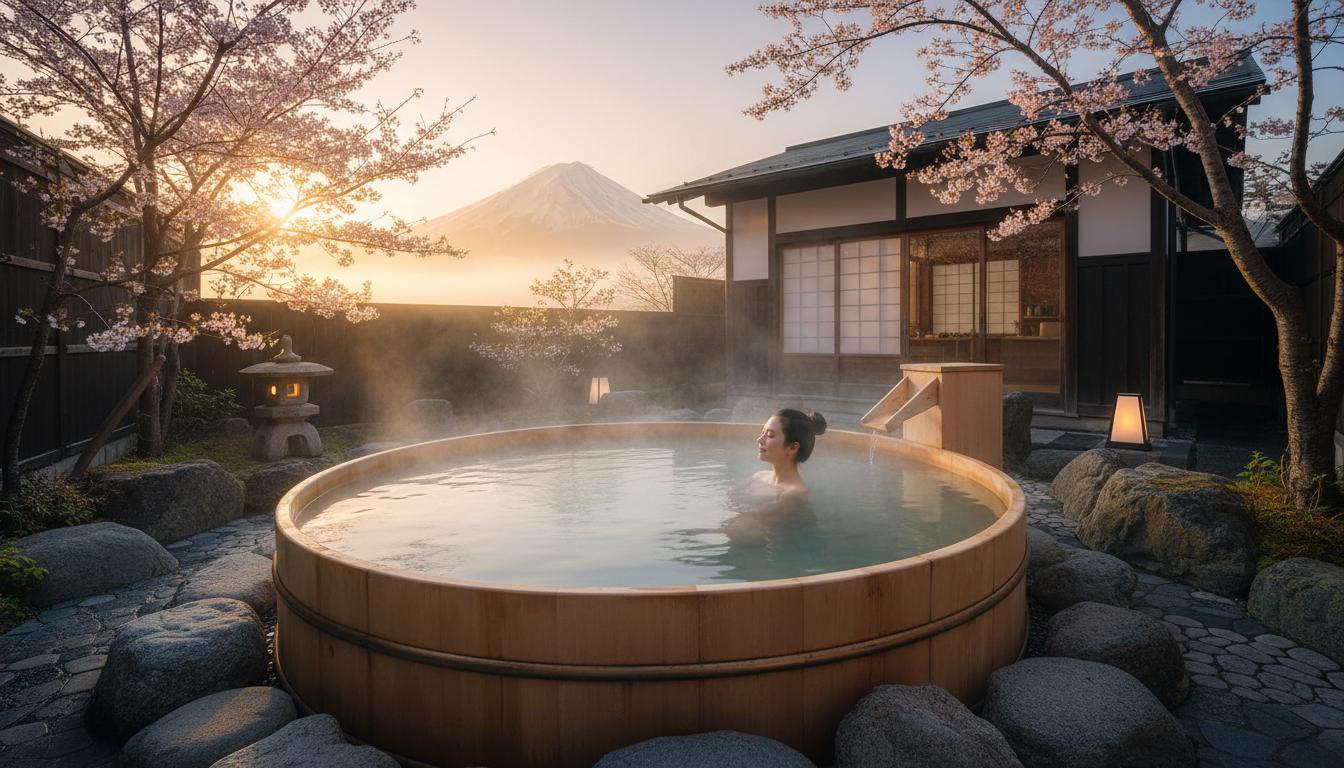
There's a specific kind of exhaustion that comes from a day of hiking around the Fuji Five Lakes. Your legs are heavy from walking the shoreline trails. Your shoulders are tight from carrying a camera bag. Your feet have been in hiking boots for eight hours and they're making their displeasure known. What you need is an onsen. Not a fancy spa with cucumber water and ambient music. A real Japanese hot spring. The kind where you sit in 42-degree water, feel your muscles surrender, and watch steam rise into the evening air while Mount Fuji glows pink in the distance. That's what this guide is about.
Yurari Onsen — Kawaguchi
Yurari is the headline act of the Fuji Five Lakes onsen scene, and for good reason. This modern bathhouse sits on the east shore of Lake Kawaguchi and features a rooftop outdoor bath with direct, unobstructed views of Mount Fuji. On a clear day — and we can't stress this enough, it needs to be a clear day — the view from the rotenburo (outdoor bath) is the best of any public onsen in the region. You're soaking in mineral-rich water, steam drifting off the surface, and Fuji rises directly in front of you like a painting that someone hung specifically for your enjoyment.
The facility is large, clean, and well-maintained. There are indoor baths of varying temperatures, a sauna, a cold plunge pool, and the signature rooftop outdoor section. The water is a simple alkaline spring — nothing exotic, but effective for sore muscles. Yurari provides towels, shampoo, conditioner, and body soap. You don't need to bring anything except yourself and ¥1,300 for the entry fee.
The best time to visit is sunrise. Yurari opens early (around 10am, but check seasonal hours), and the morning light on Fuji from the rooftop bath is worth planning your day around. Alternatively, late afternoon as the light turns golden works beautifully. Avoid midday on summer weekends — it gets crowded with tour groups and the atmosphere shifts from peaceful to social. Not necessarily bad, just different.
Price: ¥1,300 for adults. Towel rental is included.
Tattoo policy: Strict. Cover small tattoos with provided stickers. Large or extensive tattoos may be refused.
Hours: 10:00 – 21:00 (last entry 20:30). Hours vary by season.
Access: 10-minute walk from Kawaguchiko Station, or take the Retro Bus to the Yurari stop.
Fudo no Yu — Saiko
Fudo no Yu is our favorite onsen in the entire region. It's not the fanciest. It doesn't have the best view. What it has is authenticity. This is a small, community bathhouse on the east shore of Lake Saiko that feels like stepping into a different era. The building is old wood and tile. The changing room has wooden lockers that have seen decades of use. And the outdoor bath — a small, stone-lined pool surrounded by greenery — is as genuine as it gets.
The bathing setup is unusual: there's a segregated indoor section (men and women separate) and a mixed outdoor rotenburo. For the mixed bath, you can wear a swimsuit or use the modesty towel provided. Most regulars go in the traditional Japanese style, but they're used to foreign visitors and swimsuits are absolutely acceptable. The water here is simple heated spring water, not heavily mineralized, but the temperature is perfect — hot enough to work out the knots in your shoulders, not so hot that you can only stay in for two minutes.
What makes Fudo no Yu special is the atmosphere. On weekday evenings, local fishermen come here after work. They soak in silence, then sit on the wooden benches outside drinking milk from the vending machine (a classic Japanese post-onsen tradition that we still don't fully understand but have adopted). There's no English signage. The staff speak minimal English. You'll figure it out. Point at the price chart, pay your ¥500, and follow the local customs.
Price: ¥500. Bring your own towel to save the ¥200 rental fee.
Tattoo policy: Relaxed. Small tattoos generally ignored if discreet.
Hours: 11:00 – 20:00. Closed Thursdays.
Access: Take the Green Line bus from Kawaguchiko Station to Saiko and get off at the Fudo no Yu stop. Or drive — parking is free.
Benifuji no Yu — Yamanaka
Benifuji no Yu is the family-friendly option. Located on the north shore of Lake Yamanaka, this is a large, modern bathing facility that caters to groups, families with kids, and anyone who wants a comfortable, no-fuss onsen experience. The building is spacious, the facilities are extensive, and there's a free outdoor foot bath just outside the entrance that anyone can use without paying the entry fee.
The main bathing area has multiple indoor pools at different temperatures, a sauna, steam room, and an outdoor section with several pools. The outdoor area doesn't have a direct Fuji view — the building orientation puts the mountain behind you — but the sky view and the open-air atmosphere are still pleasant. The water here is sodium chloride spring, which leaves your skin feeling smooth and slightly slippery afterward. Some people love this feeling. Jake says it feels like he hasn't rinsed properly. It's normal.
The free foot bath outside is the hidden gem. It's a long, shallow stone pool that runs along the front of the building. Sit down, roll up your pants, and soak your feet while looking out over Lake Yamanaka. On a clear day, Fuji is visible in the distance. The foot bath is open to anyone, free, and stays open after the main facility closes. It's perfect if you want a quick soak without committing to a full bathing experience.
Price: ¥1,000 for adults. Foot bath is free.
Tattoo policy: Moderate. Small tattoos okay if covered.
Hours: 10:00 – 22:00 (last entry 21:00).
Access: 15-minute walk from Yamanakako bus terminal, or drive (free parking).
Saiko Iyashi no Sato — Free Foot Baths
Saiko Iyashi no Sato is a reconstructed traditional village on the west shore of Lake Saiko, built on the site of a village that was destroyed by a landslide in 1966. Today it's a cultural attraction with thatched-roof houses, craft workshops, and — most importantly for our purposes — free outdoor foot baths scattered throughout the village. These are simple stone pools fed by natural spring water, available to anyone visiting the village.
The foot baths are not fancy. They're stone-lined pools with wooden benches. But the setting is what makes them special. One of them sits at the edge of the village with views across the lake toward the Aokigahara forest. Another is tucked into a garden area surrounded by flowers in season. You can walk the village, try your hand at traditional crafts (additional fees apply), and soak your feet whenever you need a rest.
The village itself has an entry fee of ¥500, which gives you access to all the foot baths, the craft demonstrations, and the village grounds. It's worth it for an hour or two of relaxed wandering. The thatched-roof houses are photogenic, especially in autumn when the surrounding trees turn color. And the combination of cultural sightseeing and free foot baths is a nice change of pace from dedicated bathing facilities.
Price: Village entry ¥500 (includes foot baths). Craft workshops extra.
Tattoo policy: Not applicable (foot baths only).
Hours: 9:00 – 17:00.
Access: Green Line bus from Kawaguchiko Station to the Iyashi no Sato stop.
Shoji-ko Campground Bath
This one barely qualifies as an onsen, but it deserves a mention because of the experience. The Shoji-ko Campground on the east shore of Lake Shoji has a basic bathhouse for campers. It's a simple concrete building with a gender-segregated bathing area, basic showers, and a small communal soaking tub. The water is heated, not naturally spring-fed. The facilities are clean but aging. So why are we including it?
Because context matters. Imagine you've spent the day hiking around Lake Shoji, taking photos of the boats at dawn, walking the shoreline trails. You're camping overnight. The temperature is dropping. You've cooked dinner on your camp stove. And now you walk 50 meters from your tent to a hot bath. The simplicity of it — hot water, a roof, the stars coming out overhead as you walk back to your tent — is perfect. It's not about luxury. It's about the contrast between the cold lake air and the hot water. It's about being clean before you crawl into your sleeping bag. For campers at Shoji, this bathhouse is a genuine amenity.
Price: Included in camping fee (¥1,200/night for tent site). Day-use not available.
Tattoo policy: Not enforced (campers only, very informal).
Hours: Roughly 7:00 – 21:00. Hours loosely enforced.
Access: Camp at Shoji-ko Campground. No car? Good luck getting here.
Private Onsen at Campgrounds
Several of the larger campgrounds in the region — particularly around Lake Kawaguchi and Lake Yamanaka — have coin-operated private family baths. These are small, enclosed bathing rooms that you rent for 30 minutes at a time. They're basic — a small tub, a shower area, a changing space — but they offer privacy that public baths don't.
The going rate is around ¥400 for 30 minutes. You insert coins into a timer by the door. When time runs out, the hot water stops. It's a slightly stressful way to bathe if you're watching the clock, but for families with kids, couples who want to bathe together, or anyone with tattoos that would exclude them from public baths, these private baths are a fantastic option.
Availability varies. The Lake Kawaguchi campground near the north shore has two private baths. The Yamanakako area has several facilities with coin-operated options. Ask at the campground office when you check in. No reservation needed — just put your name on the waiting list if they're occupied.
Tattoo Policies — What to Actually Expect
Japan's onsen tattoo policies are changing, and the Fuji Five Lakes region is more relaxed than many parts of the country. Here's the reality on the ground. Large resort-style facilities like Yurari tend to enforce stricter rules — cover small tattoos with stickers, refuse entry for extensive work. Smaller local baths like Fudo no Yu are more relaxed, especially if your tattoos aren't immediately visible. Campground baths generally don't care at all.
If you have tattoos and want to onsen-hop without stress, the private family baths are your best bet. No one sees your ink but you. The coin-operated baths at campgrounds are tattoo-friendly by default — there's no staff checking. And the foot baths at Saiko Iyashi no Sato don't involve getting undressed, so tattoos are irrelevant.
For public baths, bring waterproof tattoo cover stickers (available at drugstores in Kawaguchiko) or ask at the entrance. Be polite. Be prepared to be turned away from the stricter facilities. And remember: private baths are increasingly common. The situation is much better than it was even five years ago.
Onsen Etiquette — A Quick Refresher
Before you go, remember the basics. Wash thoroughly at the shower station before entering the bath. The soaking tub is for clean bodies only. No swimming, no splashing, no putting your towel in the water (balance it on your head or leave it on the side). No photos — cameras in bathing areas are a serious violation of privacy and will get you removed immediately. If you have long hair, tie it up so it doesn't touch the water.
Most facilities in this region don't allow people who are heavily intoxicated. Some don't allow entry immediately after eating a large meal. Ask at the front desk if you're unsure about anything. The staff at most facilities are used to foreign visitors and are happy to help if you approach them politely.
What to Bring
At minimum: a small towel for washing (and modesty, if needed), your entry fee in cash, and a change of clothes. Many facilities provide bath towels and toiletries, but not all. Fudo no Yu charges ¥200 for towel rental, which is why we recommend bringing your own. Yurari includes towels in the entry fee. Check before you go.
After your soak, drink water. Onsen bathing is dehydrating, especially if you use the sauna. Most facilities have vending machines with water, milk, and sports drinks. The milk thing is a Japanese tradition — something about the combination of hot water and cold milk being the perfect pairing. Jake swears by it now. We don't question it anymore.
The Bottom Line
The onsen experience around the Fuji Five Lakes ranges from world-class views at Yurari to the authentic local atmosphere of Fudo no Yu to the simple pleasure of a hot bath after a day of camping. There's something for every preference and budget. Our recommendation: do at least one fancy rooftop bath for the view, and at least one small local bath for the atmosphere. The contrast between the two is what makes the region's onsen culture so rewarding.
And if you can only do one? Go to Fudo no Yu at sunset. Bring your own towel. Soak in the outdoor bath until your fingers prune. Then sit on the wooden bench outside with a bottle of milk from the vending machine and watch the last light fade from the sky. That's the Fuji Five Lakes at their most honest.