The Fuji Five Lakes — Kawaguchi, Saiko, Yamanaka, Shoji, and Motosu — sit in a rough arc at the northern base of Mount Fuji. They were formed by volcanic lava flows that dammed up existing river valleys, which means they're all relatively young in geological terms. What matters to you: each lake offers a completely different experience, and most tourists only see one of them. Usually the wrong one.
Lake Kawaguchi — The Default Choice
Lake Kawaguchi is the most accessible, the most developed, and the most crowded of the five lakes. It's where the train from Tokyo terminates. It's where the tour buses park. It's where you'll find the ropeway, the music forest museum, the souvenir shops selling Fuji-shaped cookies, and enough hotels to fill a small city. For a first-timer who wants convenience and doesn't mind sharing the view with a few hundred other people, it's fine. It's more than fine — it's genuinely beautiful on a clear morning.
The north shore of Lake Kawaguchi has the classic Fuji reflection view. Wake up before sunrise, walk to the lakeside promenade near the Nagasaki Park area, and on a still morning you'll get the postcard shot. The problem is that everyone knows this. In summer, photographers with tripods line the shore like a defensive wall. By 6am the best spots are taken. By 7am the tour buses arrive. By 8am you're wondering if you should have stayed in Tokyo.
Here's how to do Lake Kawaguchi right. Stay overnight — don't day-trip it. The day-trippers leave by 5pm, and the evening light on the mountain from the north shore is spectacular. Book accommodation on the north shore, not the south. The south shore has more development but worse views. Walk or rent a bicycle and explore the eastern shore, where the crowds thin out significantly. Skip the ropeway — the view from the lake shore is better, and the ropeway queues are absurd in summer. And definitely skip the Kawaguchiko Music Forest. It's a museum of automated musical instruments that somehow became a major tourist attraction despite having nothing to do with Mount Fuji or the lakes. We have no idea why it's on every recommended itinerary.
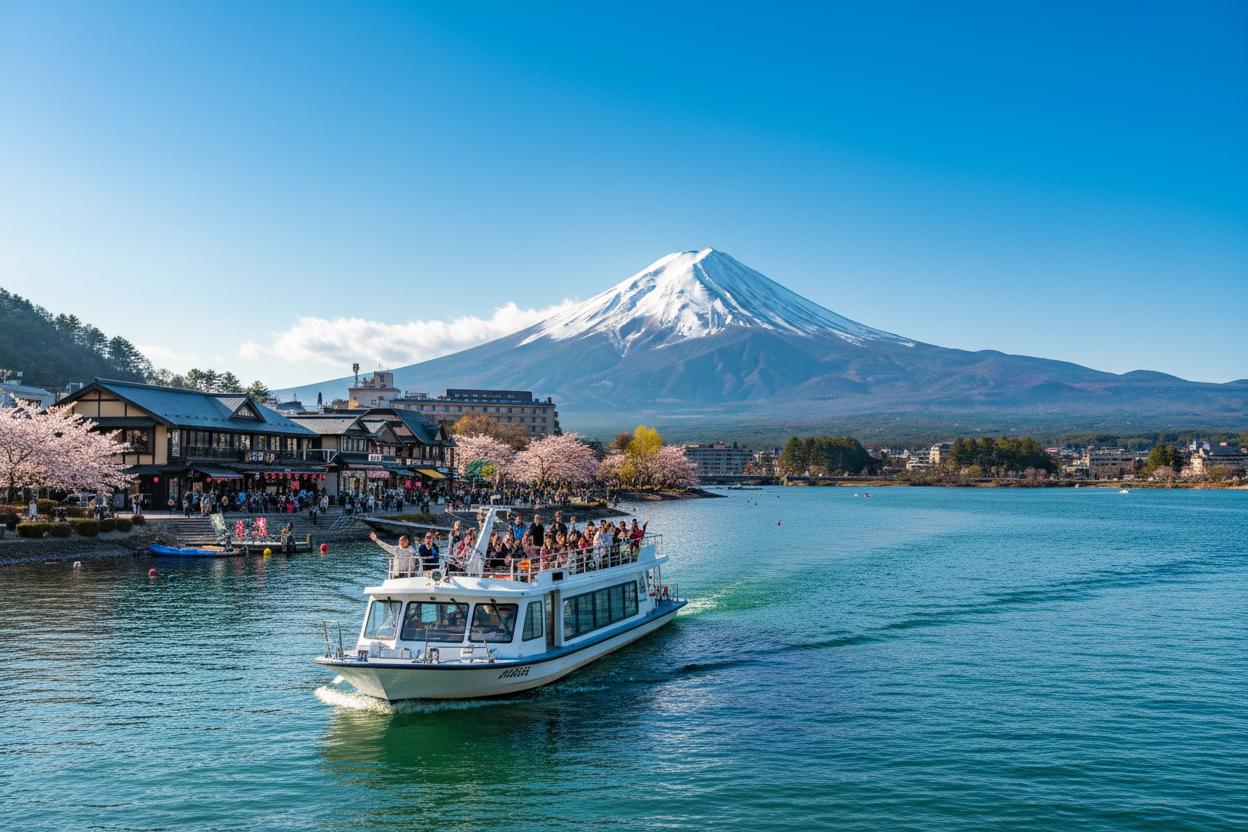
Getting to Lake Kawaguchi is easy. The Fujikyuko Line train from Otsuki Station terminates at Kawaguchiko Station on the lake's east end. From Tokyo, take the JR Chuo Limited Express to Otsuki (about 70 minutes), then transfer. Total journey is roughly 2 hours and costs around ¥2,500 one way. The direct highway bus from Shinjuku is often more convenient — about 1 hour 45 minutes, ¥2,000, and you don't have to change. Once you're at Kawaguchiko Station, local buses loop around the lake every 15-30 minutes depending on the season. A day pass costs ¥1,500.
Facilities are extensive. Convenience stores, restaurants, rental shops for bicycles and boats, hotels at every price point, and tourist information offices with English-speaking staff. The lake has a well-maintained promenade along most of the north shore, public toilets, and several parks. Entry to the lake area is free. Parking costs ¥500-¥1,000 per day at the lots near the north shore viewpoint.
Best for: First-timers, families with young kids, people without cars, anyone who wants convenience over solitude.
Skip it if: You hate crowds, you're looking for a wilderness experience, or you want to camp somewhere remote.
Lake Saiko — The Quiet One
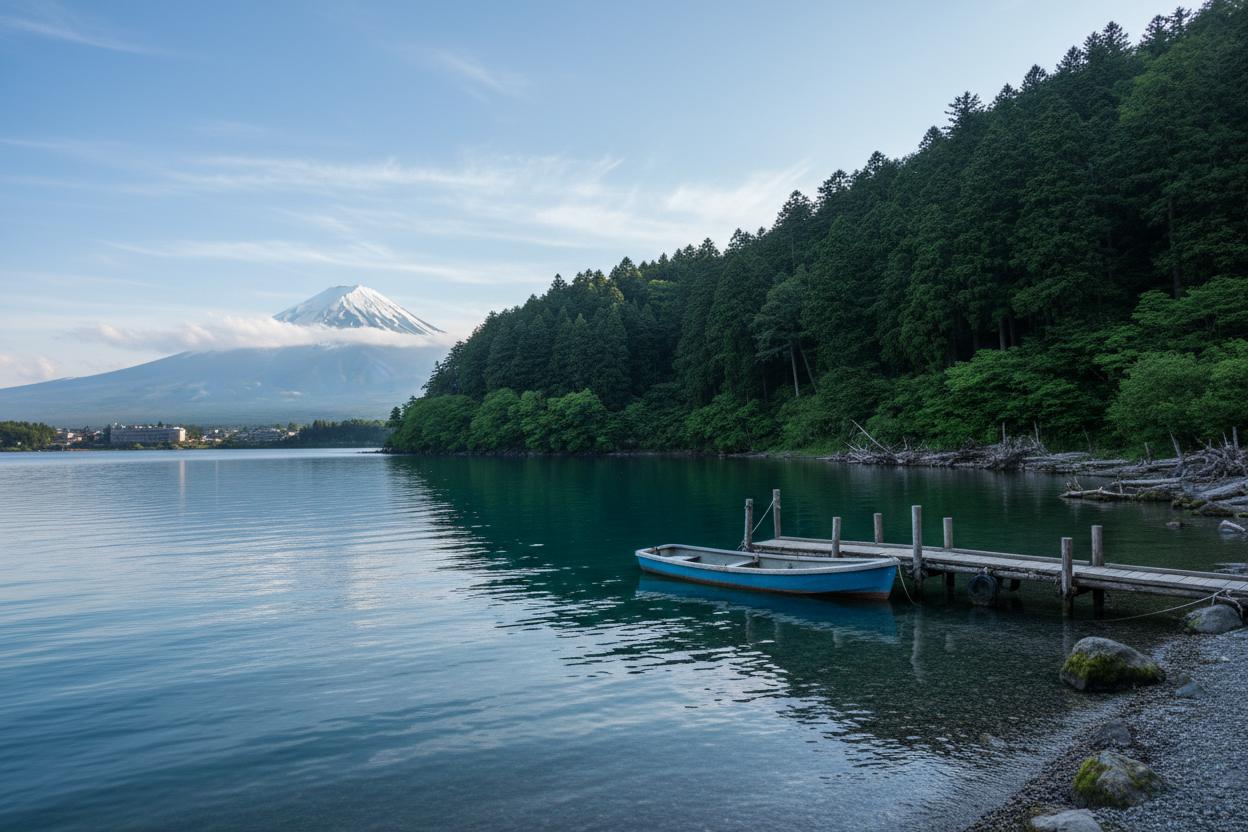
Lake Saiko is where you go when you've done Kawaguchi and realized you need something calmer. It's only 15 minutes west by car but feels like a different world. The lake sits at the edge of the Aokigahara forest — yes, that forest, but forget the sensationalist documentary nonsense. In reality, it's a beautiful, moss-covered woodland with lava caves, walking trails, and some of the most peaceful shoreline camping in the region.
The Aokigahara forest that borders Lake Saiko is a remnant of a massive lava flow from Fuji's 864 AD eruption. The trees grow directly on the volcanic rock, their roots snaking across the surface in twisting patterns that make the forest floor look like it's alive. It's green, quiet, and genuinely atmospheric. The Wind Cave and Ice Cave are worth visiting — natural lava tubes that stay cold enough to preserve ice formations even in summer. Entry is ¥350 per cave, or ¥600 for both. Wear shoes with grip; the floors are wet and uneven.
Lake Saiko has a fraction of the development of Kawaguchi. There's a small lakeside promenade on the east shore, a handful of ryokan and minshuku guesthouses, and several campgrounds that range from basic to moderately equipped. The west shore is largely undeveloped — just forest, shoreline, and the occasional fishing spot. This is where cyclists shine. The road that circles most of the lake is flat, quiet, and scenic. Rent a bike in Kawaguchi, take the bus to Saiko with it (most Saiko-bound buses have bike racks), and spend a day pedaling around.
Fudo no Yu, a small local onsen on Saiko's east shore, is one of our favorites in the region. It's ¥500, has a mixed outdoor bath (segregated by gender indoors, mixed rotenb outdoors — bring a swimsuit if you're not comfortable), and feels authentically local rather than tourist-oriented. There's no English signage. Point at the price chart and smile. They'll figure it out.
Getting to Lake Saiko without a car: take the Green Line bus from Kawaguchiko Station. It loops through the Saiko area every 30-60 minutes depending on season. A day pass is ¥1,500 and covers the Saiko and Shoji areas. The bus stops at the cave entrances, the lakeside promenade, and several trailheads. Last bus back to Kawaguchiko is usually around 6pm, so don't miss it unless you want an expensive taxi ride.
Best for: Cyclists, people who want forest walks, campers seeking a quieter alternative to Kawaguchi, cave enthusiasts.
Skip it if: You need hotel infrastructure, you want nightlife or restaurants, or you're uncomfortable with limited public transport.
Lake Yamanaka — The Family Lake
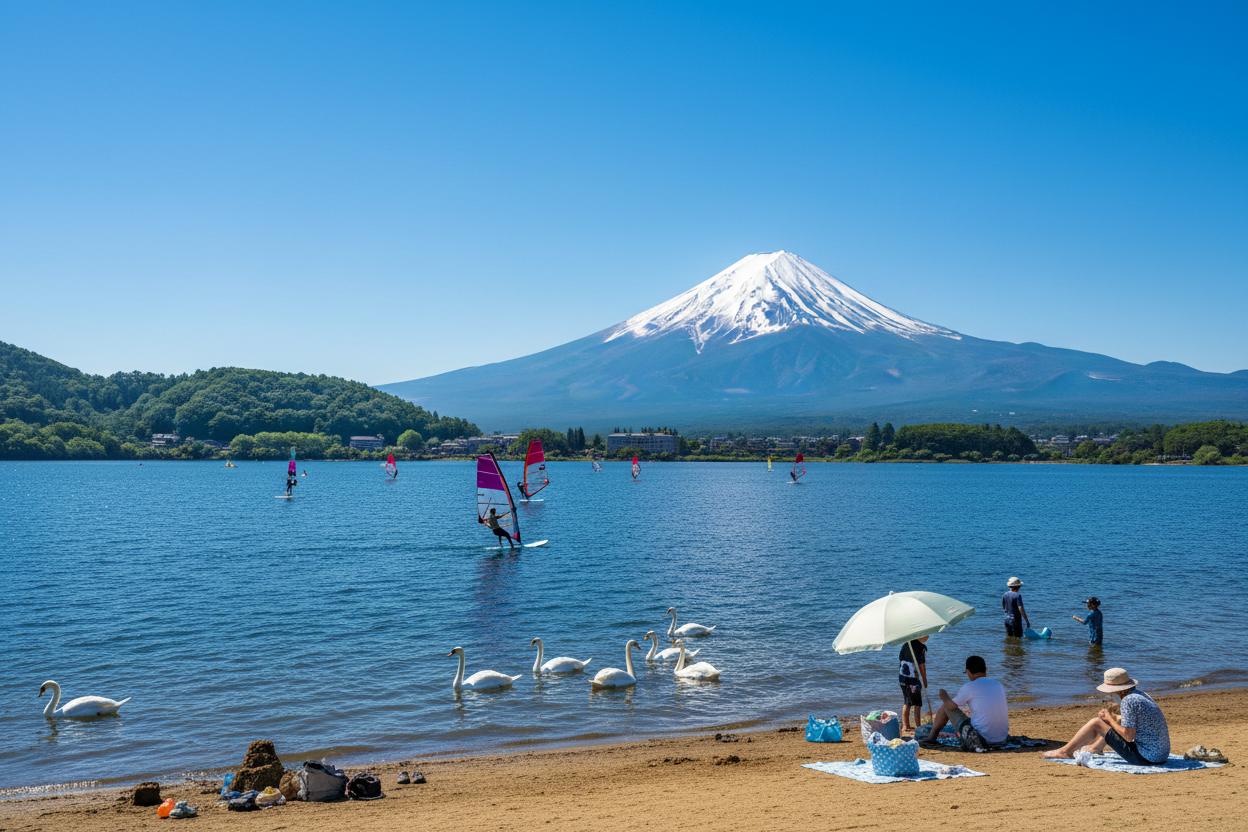
Lake Yamanaka is the largest of the five lakes by surface area and the most family-friendly. It's also, on clear days, the lake with the most direct, unobstructed view of Mount Fuji. The mountain sits directly south of Yamanaka, and the flat shoreline means you get a full, frontal view with nothing in the way. The catch: Yamanaka is popular with Japanese domestic tourists, especially families, and the lakeside area can feel like a beach resort on summer weekends.
What makes Yamanaka different is the activity scene. Windsurfing and sailing schools line the southern shore. Swan boats — actual white swans, both real birds and the pedal kind — are a thing here. The Yamanakako Communication Plaza Kirara has a sandy beach area that's popular with kids. There are multiple onsen facilities, including Benifuji no Yu, a large, modern bathhouse with indoor and outdoor pools, family-friendly facilities, and a free foot bath outside the entrance that's perfect for a quick soak without committing to a full bathing experience.
The cycling around Yamanaka is excellent. The road circles most of the lake and is mostly flat. There are dedicated rental shops near the bus terminal. Jake's recommendation: rent a bike, ride the eastern shore to the Hirano area, and find the small park where local families gather for barbecues. There's a convenience store nearby. Buy an ice cream. Watch the windsurfers. This is a Sunday afternoon kind of lake.
Yamanaka has more accommodation options than Saiko but fewer than Kawaguchi. There are several large resort-style hotels on the south shore, numerous minshuku guesthouses, and a handful of campgrounds. The Yamanakako area has enough restaurants to keep you fed, though most close early — don't expect late-night dining.
Getting to Lake Yamanaka: take the bus from Kawaguchiko Station. The journey takes about 30 minutes and costs ¥580. Buses run roughly hourly. A car is more convenient if you're staying multiple days and want to explore the other lakes, but Yamanaka is manageable by bus if your plans are lake-focused. Parking at the lakeside lots is ¥500 per day.
Best for: Families with kids, windsurfers, anyone who wants the clearest possible Fuji view, beach-day people.
Skip it if: You want wilderness solitude, you hate resort-town vibes, or you're looking for challenging hiking.
Lake Shoji — The Photographer's Secret
Lake Shoji is the smallest of the five lakes and, in our opinion, the most photogenic. The classic shot — the one you've probably seen on Instagram without knowing where it was taken — features wooden fishing boats lined up on the still water with Fuji perfectly reflected behind them. That's Lake Shoji at dawn. The boats are left anchored overnight by local fishermen, and in the early morning, before the wind picks up, the reflections are mirror-perfect.
The problem with Lake Shoji is accessibility. Without a car, it's a hassle. The bus from Kawaguchiko comes only every 1-2 hours and the schedule seems designed to confuse tourists. With a car, it's 20 minutes from Kawaguchi and there's a small parking area near the north shore viewpoint. The parking lot holds maybe 15 cars, which on a busy morning means you need to arrive early or wait.
There's almost no development at Lake Shoji. A few houses, a small campground on the east shore, and that's about it. No convenience stores, no restaurants, no hotels. It's the lake you visit for an hour or two — preferably at sunrise — and then move on. But those hours are worth it. Priya calls it "the reward for getting up at 4am." She's not wrong.
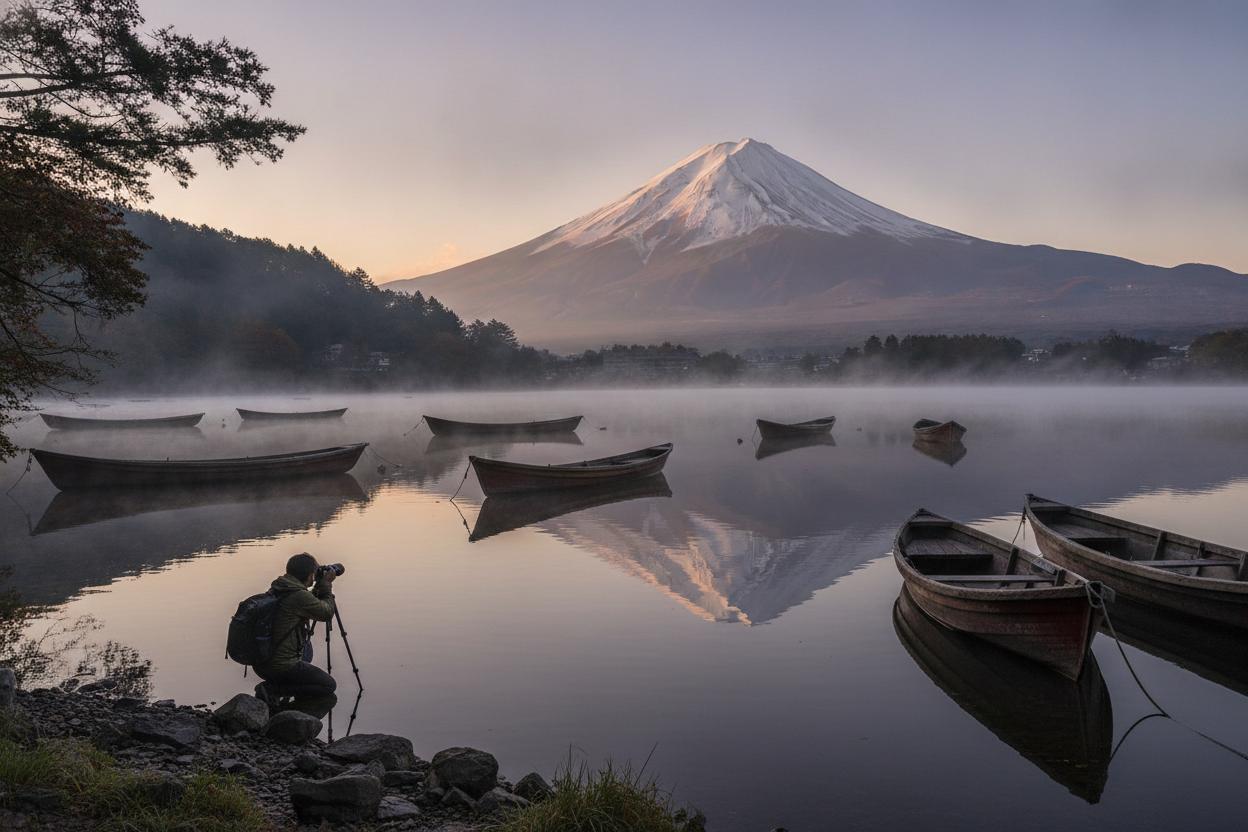
For photographers: the best spot is the north shore near the boat launch area. Bring a wide-angle lens and a tripod. The light is best 30 minutes before to 30 minutes after sunrise. In autumn, mist rises from the lake surface and adds another layer to the composition. In winter, the boats are sometimes removed, so check before making a special trip.
The small east-shore campground accepts walk-in campers and is one of the quieter spots in the region. Facilities are basic — toilets, a water source, and that's about it. But the setting, with the forest behind you and the lake in front, is hard to beat. ¥1,200 per night. No reservations — just show up and find a spot.
Best for: Photographers, sunrise chasers, people with cars, anyone who wants the classic Fuji reflection shot.
Skip it if: You don't have a car, you're not a morning person, or you need facilities and convenience.
Lake Motosu — The Wild One
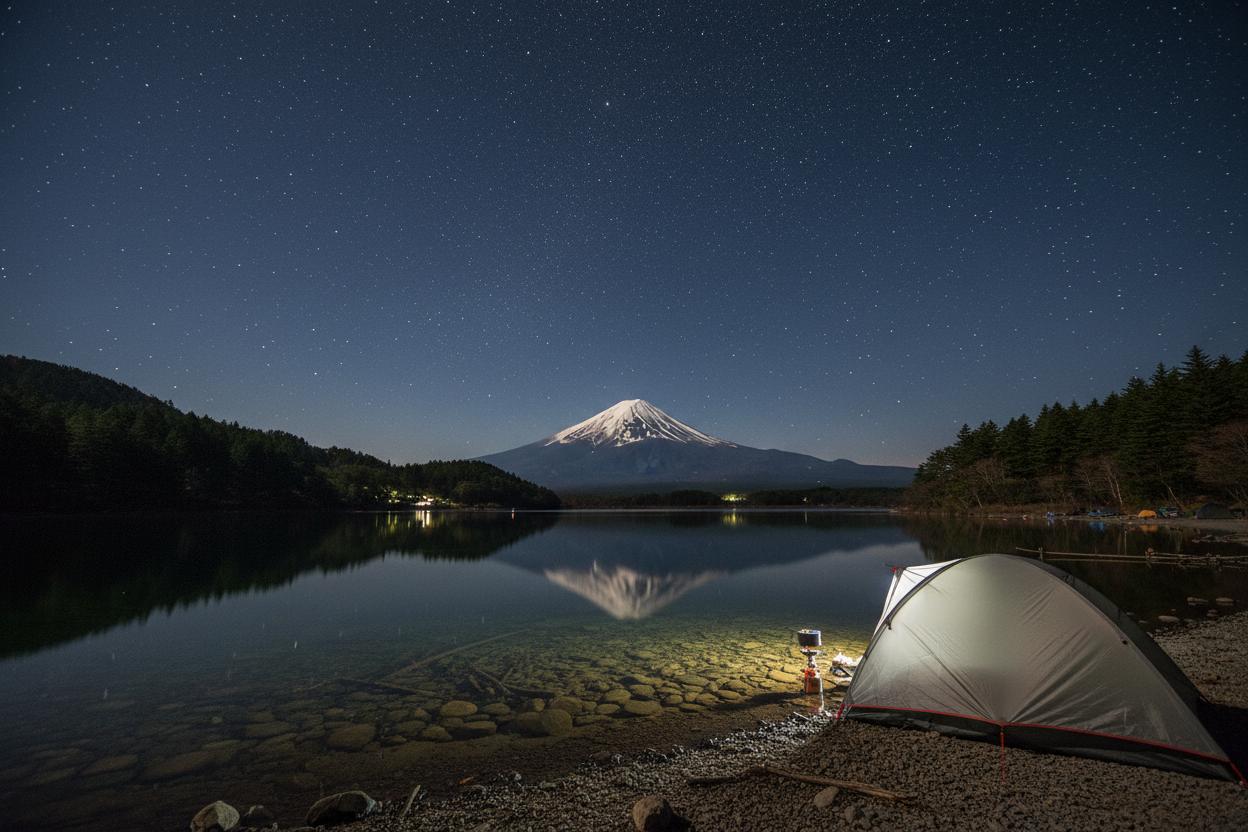
Lake Motosu is the deepest of the five lakes at 121 meters, the most remote, and our personal favorite. This is the lake featured on the reverse side of the old ¥1,000 banknote — Fuji in the background, the lake in the foreground, forest on the slopes. The view from the north shore camping area is, in our completely biased opinion, the best in the entire region. Especially at night.
What makes Motosu special is what's not there. No convenience stores. No hotels. No restaurants. No tour buses. Just a single road that winds down from the main highway to the lake shore, a handful of campgrounds, and enough silence that you can hear the wind moving through the trees on the far shore. On a clear night, the stars are overwhelming. Priya has shot the Milky Way arching directly over Fuji's summit from here more times than she can count. At 2am, with a headlamp and a tripod, she'll be the only person awake for kilometers.
The main campground, Motosu-ko Campground, sits directly on the lake shore. It has basic toilets, cold-water sinks, and coin-operated showers that cost ¥200 for 5 minutes of water that is technically hot if you're generous with the definition. There are no food vendors. You must bring everything you need — food, water, cooking equipment, warm clothes. Nights at Motosu get cold even in August. The wind comes down off the mountain and finds every gap in your equipment. Jake's tent collapse story? This is where it happened. He didn't stake the corners properly at 9pm, the wind picked up at 1am, and by 2am he was carrying his sleeping bag to the car. Learn from his mistakes.
Access to Lake Motosu requires a car. There is no bus service. The road from the main highway (Route 709) is narrow and winding — about 15 minutes of careful driving. In winter, the road sometimes closes due to snow or ice. Check conditions before you go. Once you arrive, there's a parking area at the main campground. If you're camping, parking is included in the site fee. Day-use parking is ¥500.
The campground operates on a first-come, first-served basis. In summer weekends, it fills up by Friday afternoon. Arrive Thursday if you can, or have a backup plan. The sites closest to the lake shore are the best but also the windiest — there's a trade-off between view and shelter. Sites further back are protected by trees but lack the direct lake view. ¥1,500 per night for a tent site.
Best for: Experienced campers, stargazers, solitude seekers, people who genuinely want to get away from everything.
Skip it if: You're not comfortable with basic facilities, you don't have a car, it's your first time camping, or you're visiting in winter without checking road conditions.
Quick Comparison
Best overall view: Lake Yamanaka (clearest, most direct)
Best reflection photo: Lake Shoji (dawn, boats, still water)
Best for first-timers: Lake Kawaguchi (easy access, facilities, English support)
Best for camping: Lake Motosu (stars, solitude, scenery) or Lake Saiko (quieter than Kawaguchi, forest setting)
Best for families: Lake Yamanaka (activities, beach, facilities)
Best for cyclists: Lake Saiko (flat, quiet roads, scenic)
Best onsen: Yurari at Kawaguchi (rooftop view) or Benifuji at Yamanaka (family-friendly)
Cheapest overall: Lake Saiko (lower accommodation costs, cheaper camping)
The Honest Truth About Fuji Views
We need to talk about the weather. Mount Fuji is visible from all five lakes, but it's not visible every day. Clouds are the enemy, and they form around Fuji with frustrating frequency. Summer afternoons are the worst — convective clouds build up around the summit and obscure it completely. Morning is consistently better than afternoon. Winter has the clearest skies but the coldest temperatures. Spring and autumn are your best bets for a clear view, but there's never a guarantee.
We've met people who visited for three days and never saw the mountain once. We've also met people who showed up on a random Tuesday in November and got the clearest view of their lives. The mountain doesn't care about your schedule. Our advice: plan to stay at least two nights in the region. That gives you two mornings for a chance at a clear view. And if you get clouds? The lakes are still beautiful. The onsen still feels incredible. The camping is still worth it. Don't let Fuji obsession ruin the rest of the experience.
The best tool for checking visibility isn't an app — it's the Fuji Five Lakes live camera feeds. Check them before you leave your accommodation in the morning. If the mountain is clear, go immediately. If it's clouded in, sleep in and try later.