Let's be clear about something upfront: we don't think climbing Mount Fuji is a bad experience. We think it's a misunderstood experience. The mountain is marketed as a spiritual journey, a bucket-list achievement, a quintessential Japan moment. What it actually is: a steep, cold, crowded hike up a volcano that requires preparation, realistic expectations, and a tolerance for discomfort that most travel blogs don't mention. Jake climbed it three times. The third time was when he finally accepted that the lakes are better.
The Official Season
You can only climb Mount Fuji during the official climbing season: early July to mid-September. Outside these dates, the mountain stations are closed, the trails are unstaffed, and climbing is strongly discouraged due to dangerous weather conditions. Every year, people ignore this. Every year, rescue teams are called out. Don't be that person. The season exists because above the tree line, Fuji is exposed to rapidly changing weather, high winds, and temperatures that drop below freezing even in August. Off-season climbers die. It's not dramatic — it's statistics.
The season's exact dates vary slightly by trail. The Yoshida Trail (the most popular route, starting from the Fuji-Subaru Line 5th Station) typically opens around July 10 and closes September 10. The Subashiri, Gotemba, and Fujinomiya trails have similar windows but can differ by a few days depending on conditions. Check the official Fuji climbing website for current season dates before you plan anything.
Within the season, weekends in July and August are the busiest. August is particularly crowded because it's school holidays. If you must climb, choose a weekday in early July or early September. The weather is slightly less predictable in early July (snow can linger on the upper slopes), but the crowds are significantly thinner. September has the most stable weather and fewer people, but some mountain huts begin closing after the Obon holiday in mid-August.
The Altitude Problem
Mount Fuji's summit is 3,776 meters above sea level. The Yoshida Trail starts at the 5th Station, which is already at 2,300 meters. That means you're gaining about 1,500 meters of elevation. But the real issue isn't the total gain — it's the altitude you reach. Above 2,500 meters, altitude sickness becomes a genuine risk, and by Station 8 (around 3,100 meters), it affects more than 30% of climbers.
Altitude sickness doesn't care how fit you are. It doesn't care if you run marathons. It's about how your body responds to reduced oxygen pressure, and that response is largely genetic. Symptoms start with a headache and mild nausea. They progress to vomiting, dizziness, and confusion. Severe cases can develop into High Altitude Pulmonary Edema (HAPE) or High Altitude Cerebral Edema (HACE), both of which can be fatal. On Fuji, these severe cases are rare but not unheard of.
The standard advice for preventing altitude sickness: climb slowly, stay hydrated, and consider staying at a mountain hut around Station 7 or 8 to acclimatize before the final push. The "bullet climb" — starting from the 5th Station at night and pushing straight to the summit without sleeping — is popular because it saves money on hut fees. It's also the approach most likely to make you feel like death at 3,000 meters. Jake did it twice. The second time, he vomited behind a rock at Station 8 and had to sit down for 45 minutes while a line of headlamp-wearing climbers stepped around him. Not his finest moment.
Practical prevention: spend a day at the 5th Station before climbing. Walk around, let your body adjust to 2,300 meters. Bring Diamox (acetazolamide) if you have a prescription — it helps with acclimatization. Drink water constantly, more than you think you need. And if you start feeling genuinely awful, turn around. The summit isn't worth your health.
The Crowds — A Traffic Jam at 3,000 Meters
Here's the thing nobody tells you: climbing Fuji at night with a conga line of 200 people is not spiritual. It's a traffic jam at 3,000 meters. The standard schedule has you arriving at the 5th Station around 9pm, starting the climb at 10pm, and reaching the summit for sunrise around 4:30am. Every single person on the mountain has the same plan. The trail becomes a single-file line of headlamps moving at the speed of the slowest person ahead of you. There are bottlenecks at steep sections where you stand still for 10 minutes, breathing cold air, wondering why you thought this was a good idea.
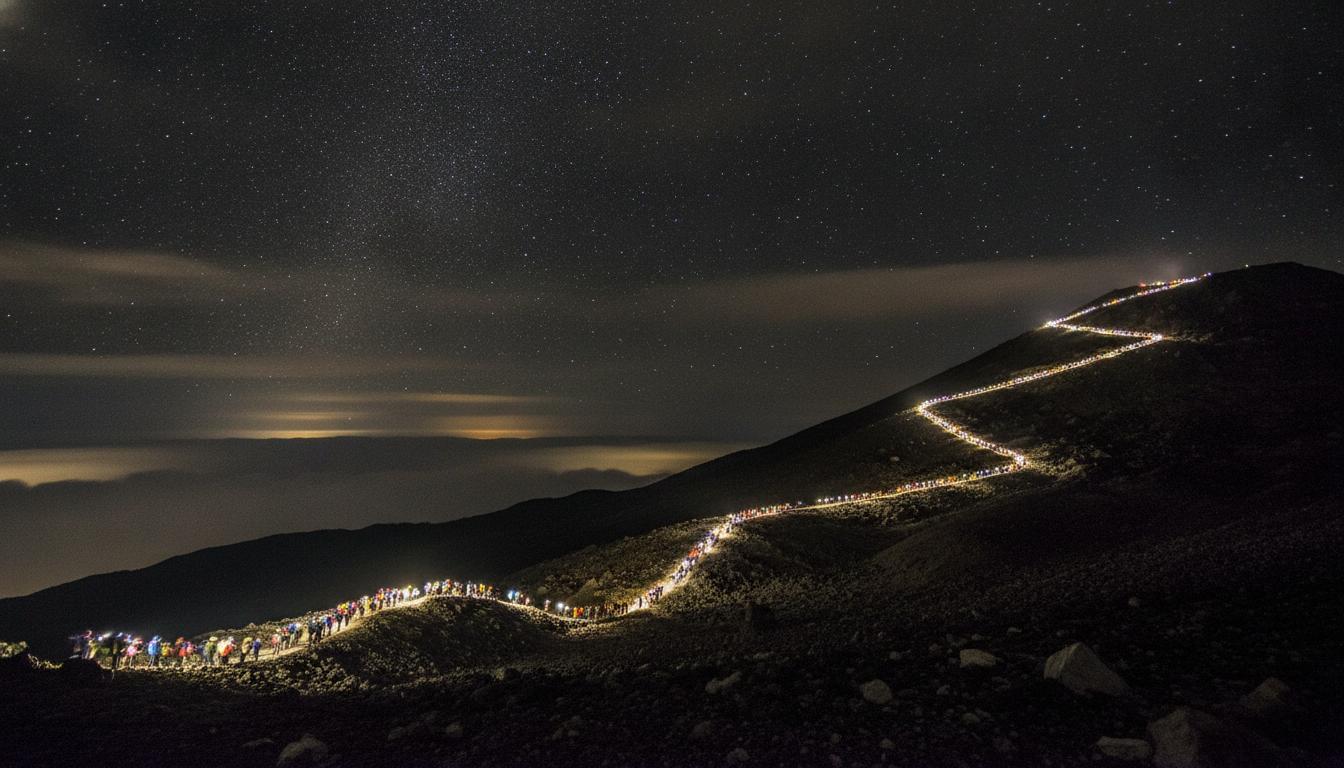
The worst section is between Station 8 and the summit. This is where the trail narrows, the altitude is affecting everyone, and the pace slows to a crawl. On a busy August weekend, this section can take 2-3 hours. The estimated 90-minute push becomes a frozen, frustrating ordeal. You'll hear people vomiting behind rocks. You'll see someone sitting down looking gray. You'll smell the portable toilets at each station from 50 meters away. This is the reality.
Weekdays are better. Early July and early September are better. But even on a "quiet" day, you're never alone on the Yoshida Trail. There are four trails up Fuji, and the Yoshida is by far the most popular. If you want fewer people, consider the Subashiri Trail (which joins Yoshida near the summit but starts on the opposite side) or the Gotemba Trail (longer, less developed, significantly fewer people). The Fujinomiya Trail is the shortest but also steep and crowded because it's the route from the south side.
Mountain Huts — ¥7,000 for a 4-Hour Nap
The mountain huts on Fuji are not hotels. They're not lodges. They're basic wooden structures that exist to give climbers a place to lie down for a few hours before continuing. And they charge ¥7,000 to ¥10,000 for the privilege. For that price, you get a futon on the floor in a room packed with dozens of other climbers, separated by nothing more than a few inches of space. The person next to you will snore. Someone will rustle a plastic bag at 1am. The lights are on all night because people are constantly arriving and departing.
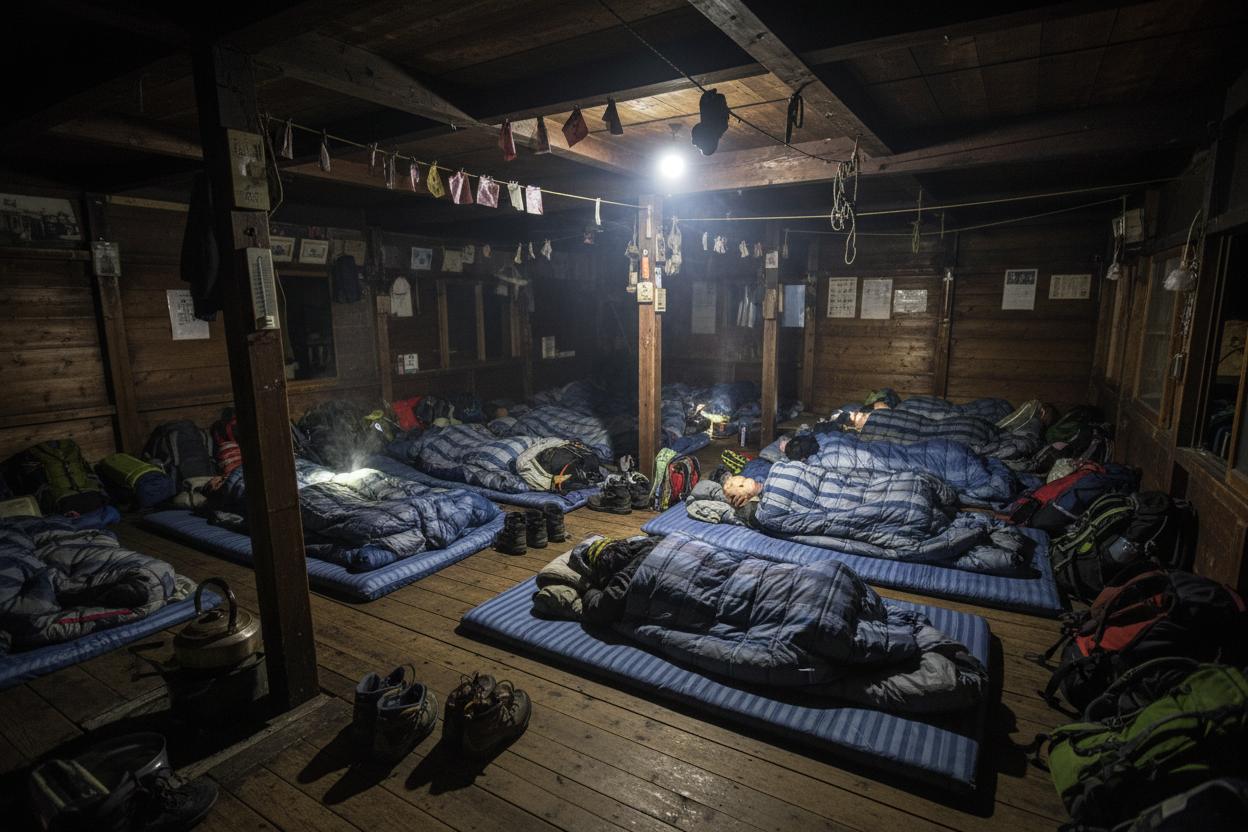
Jake's first hut experience cost ¥8,500. He arrived at Station 7 around 10pm, was shown to a futon in a room with approximately 40 other people, and managed about 3 hours of fragmented sleep before his 2am alarm. Was it worth it? He says yes — the rest helped with the altitude, and being already at Station 7 meant the final push was shorter. But he also says you need to go in with the right expectations. This is not a cozy alpine lodge with hot chocolate and a fireplace. This is survival infrastructure on a volcano.
Hut reservations are mandatory in the high season and strongly recommended year-round. Most huts don't have online booking in English. You'll need to either book through a Japanese-speaking friend, use a booking service like the official site, or call directly. Popular huts like Goraiko-sanso (near Station 8, known for its sunrise views) book up weeks in advance for August weekends. Walk-in availability exists but is unreliable — don't count on it.
What you get at a hut: a futon, usually a simple dinner (curry rice or similar) and breakfast if your timing aligns, access to toilets, and sometimes water for purchase. What you don't get: privacy, quiet, guaranteed sleep, or anything resembling comfort. Bring earplugs. Bring a sleeping mask. Bring cash — cards are not accepted anywhere on the mountain. And bring your own snacks, because hut food is basic and expensive (¥500 for a cup noodle at Station 8).
The Summit — Vending Machines and a Queue
You made it. You're at the summit of Mount Fuji, the highest point in Japan, watching the sun rise over a sea of clouds. For about 10 minutes, it's incredible. The sky turns from black to deep blue to orange and gold. The shadow of Fuji stretches out across the cloud layer below you — a phenomenon that only happens from the summit and genuinely looks otherworldly. You feel accomplished. You take photos. You feel the cold wind at 3,776 meters and realize you're underdressed.
Then reality sets in. The summit of Fuji is not a peaceful mountaintop sanctuary. It's a volcanic crater rim with a circumference of about 3.5 kilometers, several small shrines, a post office (open in season, send a postcard from the top), and vending machines. Yes, vending machines. They sell hot drinks for ¥300 and they're one of the most welcome sights you'll see after a 6-hour climb. The summit also has the highest concentration of portable toilets in Japan, and they're all disgusting by 6am. Bring ¥200 coins for toilet access — it's not free up here.
The "Kengamine" peak is the actual highest point, marked by a small shrine and a weather station. Getting a photo there requires joining a queue that can be over an hour long on busy days. Jake waited 45 minutes his first time. His second time, he skipped it. His third time, he didn't even go to the true summit — he found a quiet spot on the crater rim away from the crowds and watched the sunrise in peace. That's his recommendation: don't queue for the photo. Find your own spot.
The Descent — Worse Than the Climb
Everyone talks about the climb up Fuji. Nobody warned us about the descent. The Yoshida Trail descent follows a different path from the ascent — a long, zigzagging route down the volcanic scree slope that is, without exaggeration, knee-destroying. The surface is loose gravel and volcanic rock that slides under your feet with every step. You slip, you skid, and after about 30 minutes your knees start complaining. After an hour, they're screaming. By the time you reach the 5th Station, you'll understand why walking poles are not optional — they're survival equipment.
The descent takes 3-5 hours depending on your pace and your knees' cooperation. There's no shade. There's no scenery — just gray scree and dust. The dust gets everywhere: in your shoes, in your lungs, in your camera equipment. Wear a buff or mask. Wear gaiters to keep the scree out of your boots. And seriously, use walking poles. Two of them. Your knees will thank you for the next decade.
About halfway down, you'll pass the trail junction where the Subashiri Trail merges. From here on, the path gets more crowded and the surface slightly less scree-heavy. The last section before the 5th Station is a dusty dirt road that feels like it goes on forever. When you finally see the 5th Station buildings, it's a mix of relief and disbelief that you paid money for this experience.
The Better Alternative — Yoshida Trail Day Hike
If you want the Fuji climbing experience without the crowds, the altitude sickness, the hut fees, and the 2am start, do this instead: hike the Yoshida Trail from the 5th Station to Station 7 or 8 during the day, then turn around and come back down. You'll be above the tree line, you'll get incredible views of the surrounding landscape, you'll experience the volcanic terrain, and you'll be back at the 5th Station in time for lunch. Cost: zero yen. Crowds: minimal on weekdays. Knee damage: negligible compared to the full descent.
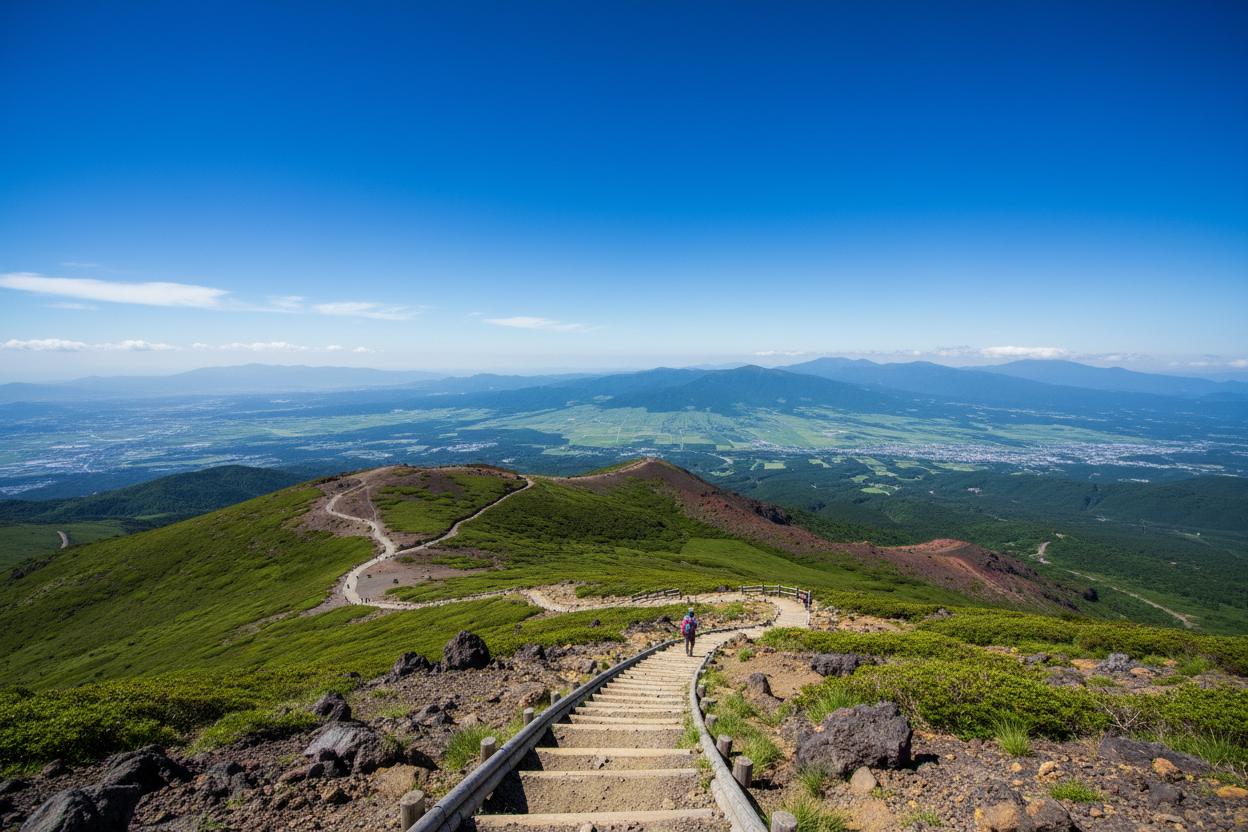
The 5th Station itself is worth a visit even if you don't hike. There are souvenir shops, restaurants, a small shrine, and panoramic viewpoints. On a clear day, you can see the Fuji Five Lakes region spread out below you. The drive up the Fuji-Subaru Line (the toll road to the 5th Station) is spectacular in itself — 30 kilometers of switchbacks through changing vegetation zones until you emerge above the tree line into volcanic terrain. The toll is ¥2,100 per car each way in season.
Our recommendation for the best compromise experience: drive to the 5th Station in the morning. Spend an hour walking around, taking in the views. Hike up to the 6th Station and back (about 45 minutes each way). Have lunch at one of the restaurants. Then drive down and spend the evening at an onsen overlooking one of the lakes. You'll see Fuji, you'll experience the mountain, and your knees will still work the next day. Priya's done the full climb once. She does the day-hike version three times a year.
What to Pack
Layered clothing is non-negotiable. At the summit in August, temperatures are around 5°C, and with wind chill it can feel below freezing. The standard approach: moisture-wicking base layer, insulating mid-layer (fleece or down), and a windproof outer shell. Bring a warm hat and gloves — yes, even in summer. You'll need them at the top.
A headlamp is essential for the night climb. Bring spare batteries. The trail is rocky and uneven, and you'll need your hands free for balance. Walking poles, as mentioned, are not optional for the descent. Two poles, not one. Trust us on this.
Bring cash. Lots of it. The mountain operates on cash only. Hut fees, toilet fees (¥100-¥200 per use), water (¥200-¥300 per bottle), food, souvenirs — none of it takes cards. Budget ¥10,000 in cash just for on-mountain expenses, plus your hut fee if you're staying overnight.
Water: bring at least 2 liters for the ascent. You can buy more at stations, but it's expensive. Food: high-energy snacks — nuts, chocolate, energy bars. The climb burns more calories than you expect. A first-aid kit with blister plasters, painkillers, and any personal medication. Sunscreen and sunglasses for the descent — the volcanic scree reflects UV intensely.
Climbing Checklist
- Layered clothing (base + fleece + windproof shell)
- Warm hat and gloves
- Headlamp with spare batteries
- Walking poles (two)
- 2+ liters of water
- High-energy snacks
- Cash (¥10,000+)
- First-aid kit with blister plasters
- Sunscreen and sunglasses
- Sturdy hiking boots (not sneakers)
- Earplugs and sleeping mask (if staying in hut)
- Buff or mask for dust on descent
The Bottom Line
Climbing Mount Fuji is a genuine achievement. Summoning at sunrise is a moment you'll remember. But go in with your eyes open. It's cold, it's crowded, it's physically demanding, and the descent will hurt. If you're prepared for all of that, you'll have a good experience. If you're expecting a serene spiritual journey, you'll be disappointed.
And honestly? Consider skipping the climb. The view of Fuji from the lakes — especially from Lake Motosu at night or Lake Shoji at dawn — is better than anything you'll see from the summit. You don't need to climb Fuji to appreciate it. Sometimes the best way to experience a mountain is from its base, with a cup of instant coffee, watching the first light hit the snow cap. That's the view we're chasing.